
Literatura e educação fortalecem a ancestralidade e a vivência indígena
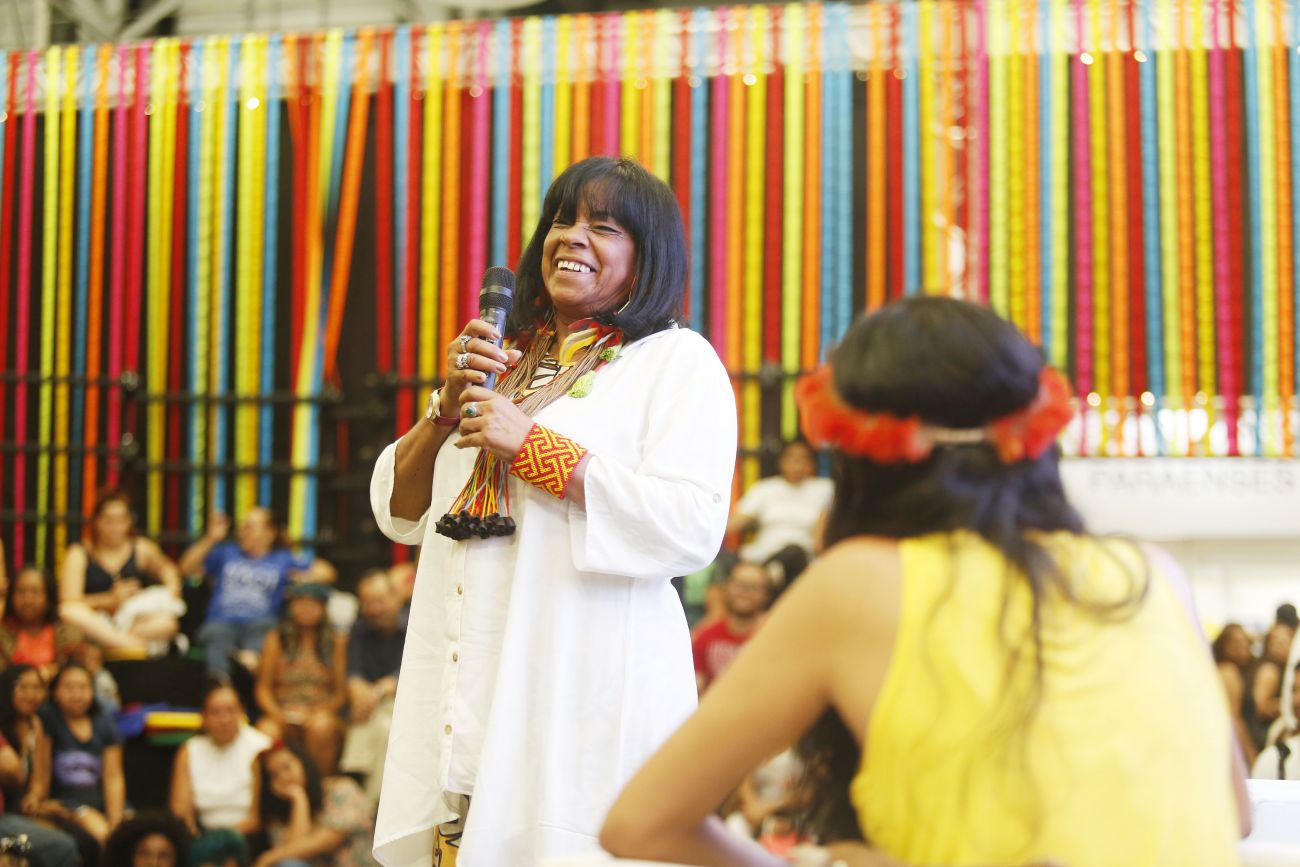
A escritora, ativista e empreendedora indígena Eliane Potiguara, no Encontro LiterárioFoto: MARIO QUADROS / ASCOM SECULT
A programação das Vozes Originárias Indígenas, na 23ª Feira Pan-Amazônica do Livro e das Multivozes, foi encerrada pela escritora, ativista e empreendedora indígena Eliane Potiguara, no Encontro Literário realizado na Arena Multivozes. As ancestralidade e a literatura indígena pautaram a participação da escritora, que destacou a importância de haver povos originários na produção literária, o que ajuda na divulgação da cultura indígena, além de abordar temas como territorialidade e tradições que fazem parte da vivência desses povos. Continue lendo
“Se matam um de nossos filhos, nós parimos mais três”: resistência e luta na 1ª Marcha das Mulheres Indígenas (por Letícia Cao Ponso)
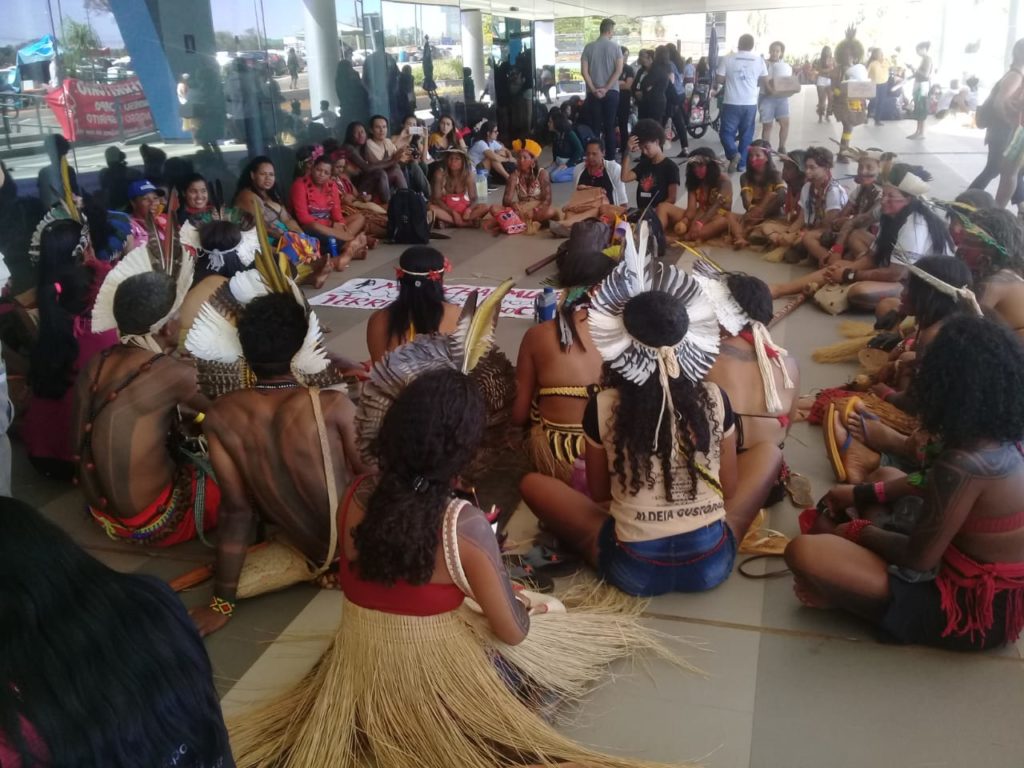
A 1ª Marcha das Mulheres Indígenas teve como tema: “Território: nosso corpo, nosso espírito”. (Foto: Letícia Cao Ponso)
Nas centenas de barracas coloridas de um acampamento no gramado do pátio externo da FUNARTE, em Brasília, entre o Planetário, o Parque da Cidade e o estádio Mané Garrincha, mulheres indígenas de 115 etnias preparam-se para a 1ª Marcha das Mulheres Indígenas, que tem como tema: “Território: nosso corpo, nosso espírito”. Continue lendo
Programação Seminário comemorativo de 20 anos do IPOL
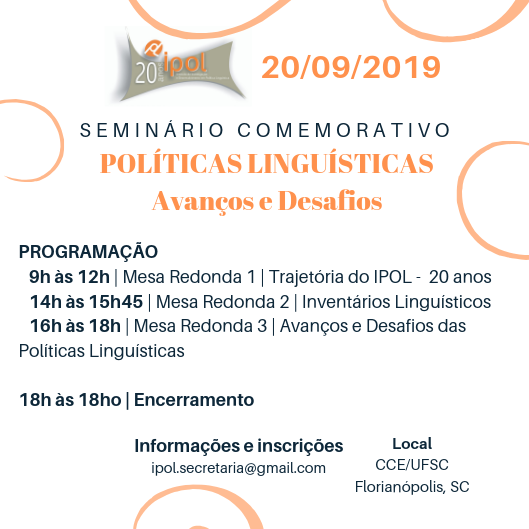 Seminário Comemorativo dos 20 anos do IPOL : Políticas Linguísticas – Avanços e Desafios
Data do evento: 20/09/2019
Horário: Das 09h00 às 18h30
Local: Sala Carlos Drummond de Andrade – CCE/Bloco B/ UFSC – Florianópolis/SC Continue lendo
Revista Brasileira de Linguística Antropológica – RBLA – V. 11, N. 1 (2019) –
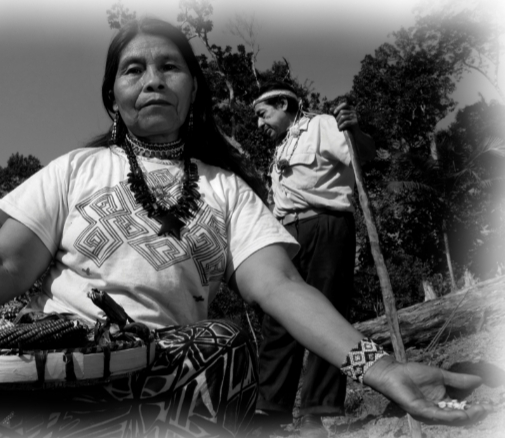 A equipe editorial da Revista Brasileira de Linguística Antropológica – RBLA tem o prazer de divulgar, ao lado da sua indicação para classificação A1, no Qualis Capes, o seu mais recente um volume: v. 11, n. 1 (2019) (DOI: https://doi.org/10.26512/rbla.v11i1). Nessa edição, ratificando o seu compromisso com a interdisciplinaridade, a RBLA apresenta sete artigos que integrando conhecimentos linguísticos, antropológicos e arqueológicos, tratam de aspectos das línguas e das culturas dos povos nativos do continente sul-americano. Continue lendo
Museu do Amanhã apresenta o programa Vivências do Tempo – Matriz Indígena
No Ano Internacional das Línguas Indígenas, celebrado pela UNESCO neste 2019, o Museu do Amanhã promove mais uma edição do programa Vivências do Tempo, dessa vez lançando a sua Matriz Indígena. Com o tema “Ecologia das línguas”, uma proposta de reconhecimento e valorização da língua e da linguagem indígenas, e de todas as histórias, tradições e memórias que elas trazem em si, as atividades acontecem nos dias 28 de agosto, de 15h às 18h, e 1º de setembro, de 17h às 19h. Continue lendo
Third International Seminar of the UNESCO Chair LANGUAGE POLICIES FOR MULTILINGUALISM: Multilingualism : Hierarchies, Inequalities, Marginalization Structures, Issues, Policies
O prazo para submissão de proposta é até 31 de agosto 2019. Participe!
Data: 23-24 January 2020
National Institute Of Oriental Languages and Civilisations (Inalco) – Paris, France
Languages have been recognized as being of central importance for people and for the planet, because of their complex implications for identity, communication, social integration, education, development and ecology. Given the vital role of languages, UNESCO has committed itself to multilingualism and linguistic diversity, especially to the issues of marginalized and endangered languages. The latter issue has been the focus of the International Year of Indigenous Languages declared by UNESCO in 2019.
Multilingualism as an area of research has addressed the question of language hierarchies and conflict, and how language planning may be brought to bear on the consequent issues of inequalities of access to services, education, information, knowledge and opportunity, and the related question of linguistic rights. The information and communication technologies revolution of recent decades has shifted to the digital plane these different concerns.
The seven research axes of the UNESCO Chair on Language Policies for Multilingualism – Internationalization, Intercultural mediation, Language education, Translation and Accessibility, Economy and Linguistic Rights, Information and Communication Technologies, Borders and Diasporas – address all of the above dimensions, with a contemporary vision of languages as resources rather than as problems.
Concepts
“We Need a Forest of Tongues,” Homer-Dixon writes in 2001 (Toronto Globe and Mail, July). It is a way of asserting that linguistic diversity is just as indispensable as biodiversity: each of the languages contains a set of linguistic particularities and cultural references that make it possible to better understand the evolution of societies and the complexity of human language. Whether majority, minority, global, national, regional, local, recognized, ignored, acclaimed or disparaged, the profusion of languages across diverse contexts and geographies constitute our ‘Forest of Tongues’.
It is a reality that languages, speakers, skills and linguistic repertoires do not have the same weight. The diffusion of languages and the circulation of knowledge illuminate various types of hierarchies between ethno-linguistic groups. The presence (or absence) of languages / cultures in cyberspace, or tangible artefacts such as grammatical descriptions, dictionaries and manuals, mark the existence (or omission) of a language community. In the play of identities, the status of a language is the expression of power relations between social groups. These factors play a key role in access to different kinds of resources and thus in shaping socio-economic outcomes as well as the vitality of languages.
The diversity of languages appears as a de facto feature of globalized information society: in a world where communication needs have never been greater, the multilingual web and widespread translation are the most spectacular illustrations of heterogeneous and intensified language contact; but they are also the sites of marked ‘linguistic divides’ – while certain languages are ubiquitous and ‘over-exposed’, others, ‘underexposed’, seek their place in the universe, or are eclipsed.
The integration of hierarchically ordered languages and cultures can be experienced in a more or less painful manner. In a multilingual world, for dialogue to take place between different communities with differential levels of language resources and access to knowledge, it is vital to learn the skills of transculturality.
Further, languages are not just defined as singular linguistic systems existing in themselves, but also by the differential capital that their mastery represents for those who speak or learn them; this capital serves as an instrument to legitimize, or not, a set of speakers. The knowledge of languages appears in the collective imaginary as an attribute of the social elite: while we marvel at the multilingual children of European parents, we remain indifferent to the rejection or the gradual abandonment of languages of origin of migrant families.
However, no language is inherently ‘pre-destined’ to be disseminated and taught, or to fade away and vanish – all languages, including those that are poorly disseminated, are both ‘local’ and ‘modern’, and all linguistic communities, however numerically small, convey the principles of universality in their own way.
To examine the world linguistic order to reveal its contradictions and asymmetries is, in a certain manner, to not accept it, and thus to find pathways to understand and address the structures of inequality and marginalization so as to enable the greatest number of language communities to survive and thrive in the global information age.
Themes of contributions
The objective of the conference is to facilitate a multidisciplinary reflection on the issues arising from language related hierarchies, inequalities and mechanisms of marginalization in multilingual societies, and the elaboration of appropriate language policies to address such issues.
- How are linguistic hierarchies and inequalities manifested? What is their significance ?
- How do they shape other types of social inequalities?
- How are they manifested in multilingual urban environments?
- What is their impact on access to education?
- Academic and professional language(s) and the status of English
- What role can language policies play in combating linguistic inequalities?
This reflection will benefit from the articulation of various experiences of the members of the Chair from a wide range of contexts.
Contributions (20 minutes) may be based on the following axes:
- Education, and teaching/learning of languages and cultures;
- Internationalization of education
- Access to Information and Communication Technologies and participation in the information society;
- Transculturality and intercultural mediation across linguistic borders;
- Role of translation in assuring accessibility;
- Realization of Sustainable Development Goals;
- Articulation of linguistic rights.
Terms of participation and contact information
Proposals of a maximum of 250 words and 5 bibliographical references must be sent by August 31, 2019 to the e-mail address of the conference leaders:
Pr. Thomas SZENDE, Europe Department, INALCO, Director Research Center PLIDAM, thomas.szende@yahoo.fr
Dr. Anuradha KANNIGANTI, South Asia Himalaya Department, INALCO, akannig@inalco.fr
Proposals must be accompanied by the attached form.

Forlibi – Fórum Permanente das Línguas Brasileiras de Imigração

I Seminário de Gestão em Educação Linguística da Fronteira do MERCOSUL
